
Criminal Cases in Shelby County Courts
The Thirtieth Judicial District Criminal Court hears Shelby County felony prosecutions at 201 Poplar Avenue. Shelby County General Sessions Criminal Court handles misdemeanors, criminal settings, and preliminary proceedings that may later lead to a grand-jury indictment. Shelby County Juvenile Court keeps youth matters under separate access rules. Bartlett and Collierville municipal courts also hear matters within their stated jurisdiction, so a city citation or preliminary hearing may begin outside the downtown Shelby County clerk system.
The Shelby County clerk is the custodian of the court case file. That Shelby County file is distinct from a police report and a jail booking. The Shelby County Criminal Court Clerk keeps felony trial files, appeals, bond and warrant records, and expungement filings. General Sessions keeps its own docket. When the question is what charge was filed or how it ended, use the Shelby County court record instead of relying on an intake charge from an arrest record.
Shelby County Felony Case Files
“201 Poplar” can mean the Shelby County jail, a Shelby County courtroom, or one of several records units. For Shelby County criminal case records, the key destination is the Criminal Court Clerk in Suite 3034, open weekdays from 8:00 a.m. to 4:30 p.m. The main number is 901-222-3200. Customer Service answers at 901-222-3376, while Bonds/Warrants uses 901-222-3229. Separate lines serve Appeals, Grand Jury, Expungements, and Mittimus, the commitment order used to carry out custody or a sentence.
The official Shelby County Criminal Court Clerk directory shows those direct units and the courthouse details.
The directory helps route a Shelby County case question to the unit that actually holds the needed record, rather than to the jail or a general county switchboard.
Criminal Court Clerk
201 Poplar Avenue, Suite 3034
Memphis, TN 38103
901-222-3200
Monday-Friday, 8:00 a.m.-4:30 p.m.
General Sessions Criminal
201 Poplar Avenue
Memphis, TN 38103
901-222-3400
Online Case Review and clerk route
Note: Security screening applies at the active court and jail complex, so confirm the relevant division's device rules before bringing electronics.
How to Search Case Records
Start with the Shelby County court that handled the proceeding. The General Sessions criminal gateway provides Online Case Review and a court-date route, but its published disclaimer says the online information may change and is not an official certified record. An indicted Shelby County felony belongs with the Criminal Court Clerk. Older or offline Shelby County court records may require a call or a file request.
- Search General Sessions Online Case Review for a misdemeanor, preliminary hearing, or initial court date.
- Record the full case number, court division, status, and next event rather than relying only on a name match.
- Check Criminal Court after indictment because the felony file may use a different count or case path.
- Use the Clerk's Jacket Request when the paper file must be delivered to the correct division.
- Ask the clerk for a certified disposition when an official copy, not a changeable screen, is required.
The official General Sessions page shows how Shelby County exposes its newer online review route.
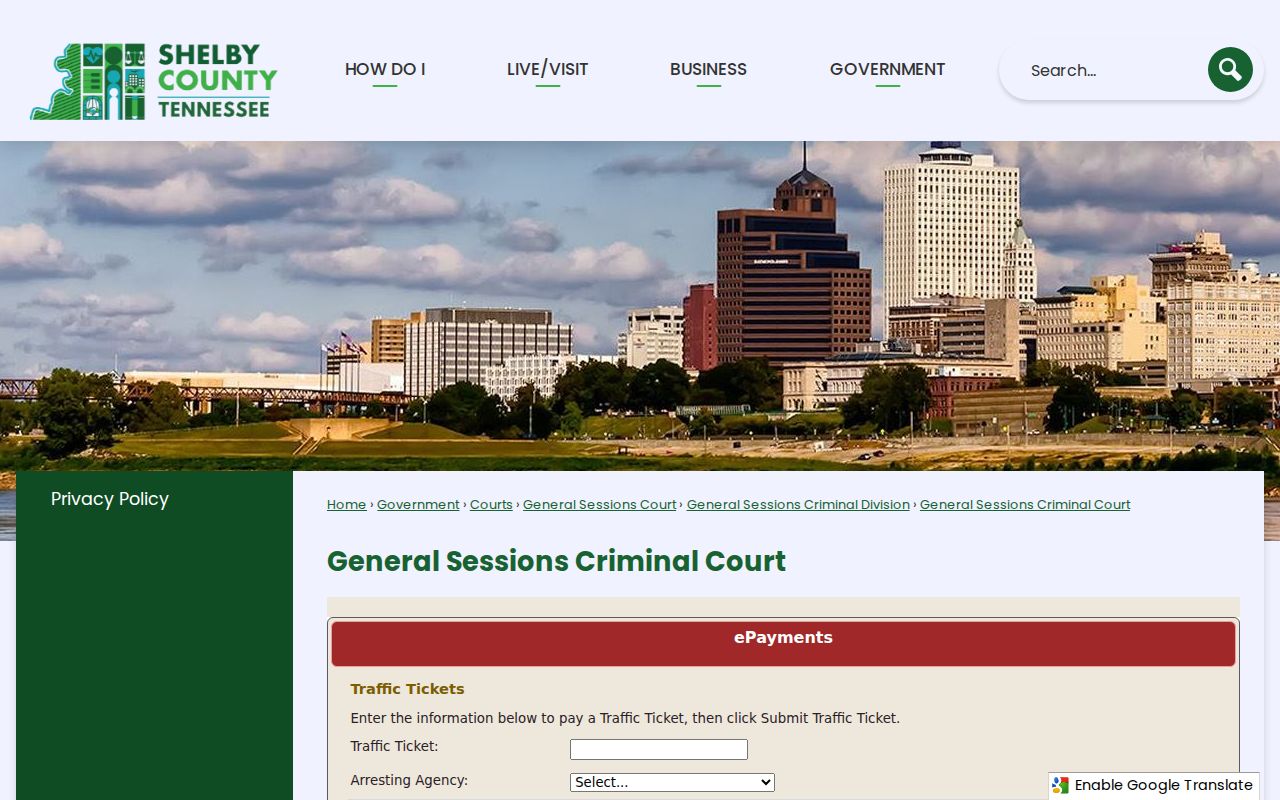
That gateway is the practical first stop for Shelby County lower-court events, while felony outcomes still require the Criminal Court record.
Shelby County Case Jacket Requests
A case jacket is the clerk-held physical file, not a statewide criminal-history report. Shelby County's online request routes that jacket to a court division. It works best when the requester already knows both the defendant name and case number. The form also asks for the set or disposition date, contact details, and notes that may help staff find the right file.
The official Jacket Request exposes a rare local rule: requests for Divisions 7, 8, and 10 ask whether permission from the judge was obtained first.
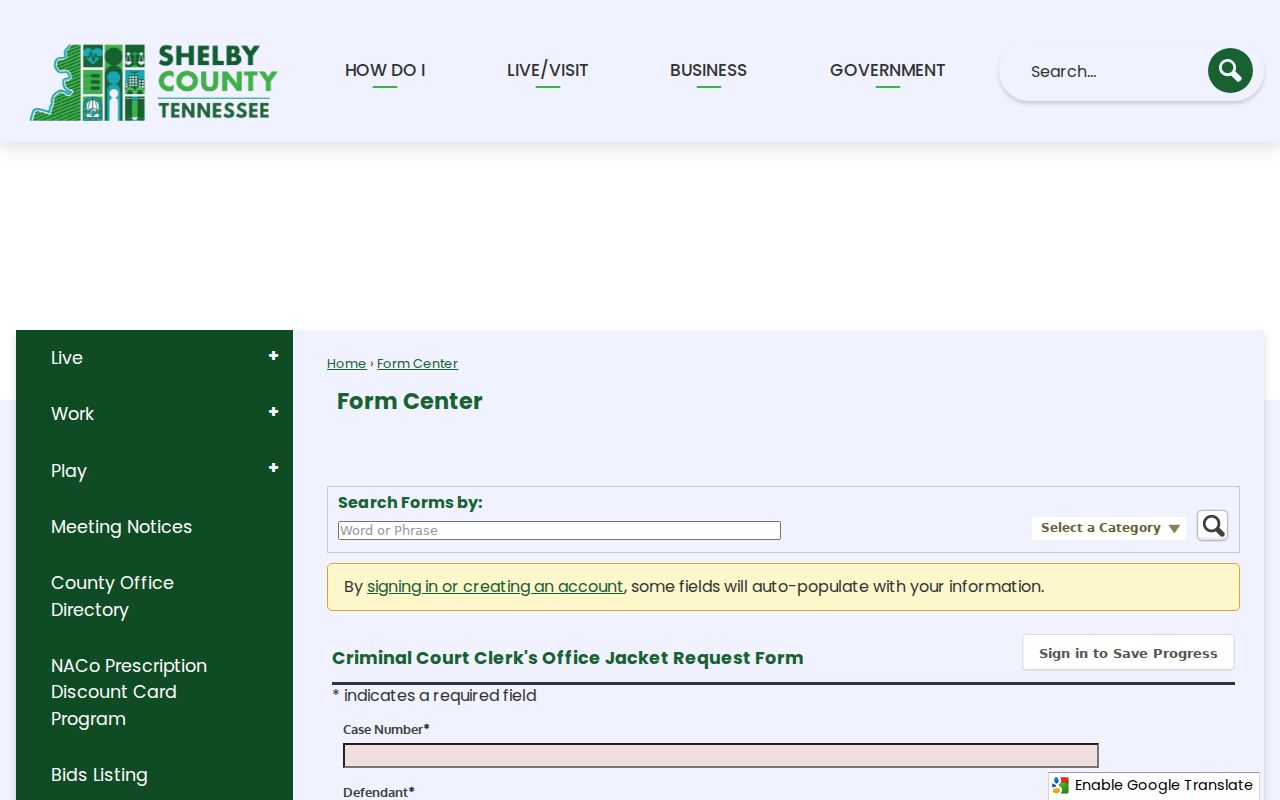
The division field and permission question show why a broad name search is not enough to deliver the correct Shelby County file.
| Field Label | Type | Required | Notes |
|---|---|---|---|
| Case Number | Text | Yes | Use the local court identifier |
| Defendant | Text | Yes | Match the docket spelling |
| Delivery Division | Text or selection | Yes | Names the court division receiving the file |
| Set/Disposition Date | Date | No | Use month/day/year when known |
| Division Permission | Yes/no | When applicable | Special question for Divisions 7, 8, and 10 |
| Requester Contact | Name, phone, email | Yes | Lets staff clarify and route the request |
What the Case File Shows
A Shelby County criminal case file follows the prosecution, not just the arrest. It can show the charging instrument, division, docket events, public motions, pleas, judgment, sentence, and court costs. The docket is a dated register of filings and hearings. A disposition is the legal result of each charge, such as conviction, dismissal, acquittal, or a prosecutor's decision not to proceed.
| Case Number & Court | Identifies the local file, division, and court level. |
|---|---|
| Charging Document | Shows the complaint, information, presentment, or indictment used in court. |
| Docket Entries | Lists filings, appearances, motions, orders, and changes in sequence. |
| Hearing Dates | Shows the date, time, division, and event type when public. |
| Disposition & Judgment | Records how each filed count ended and whether guilt was adjudged. |
| Sentence & Conditions | May state confinement, probation, restitution, fines, costs, or other orders. |
The Criminal Court forms index also routes correction and certified-copy requests.
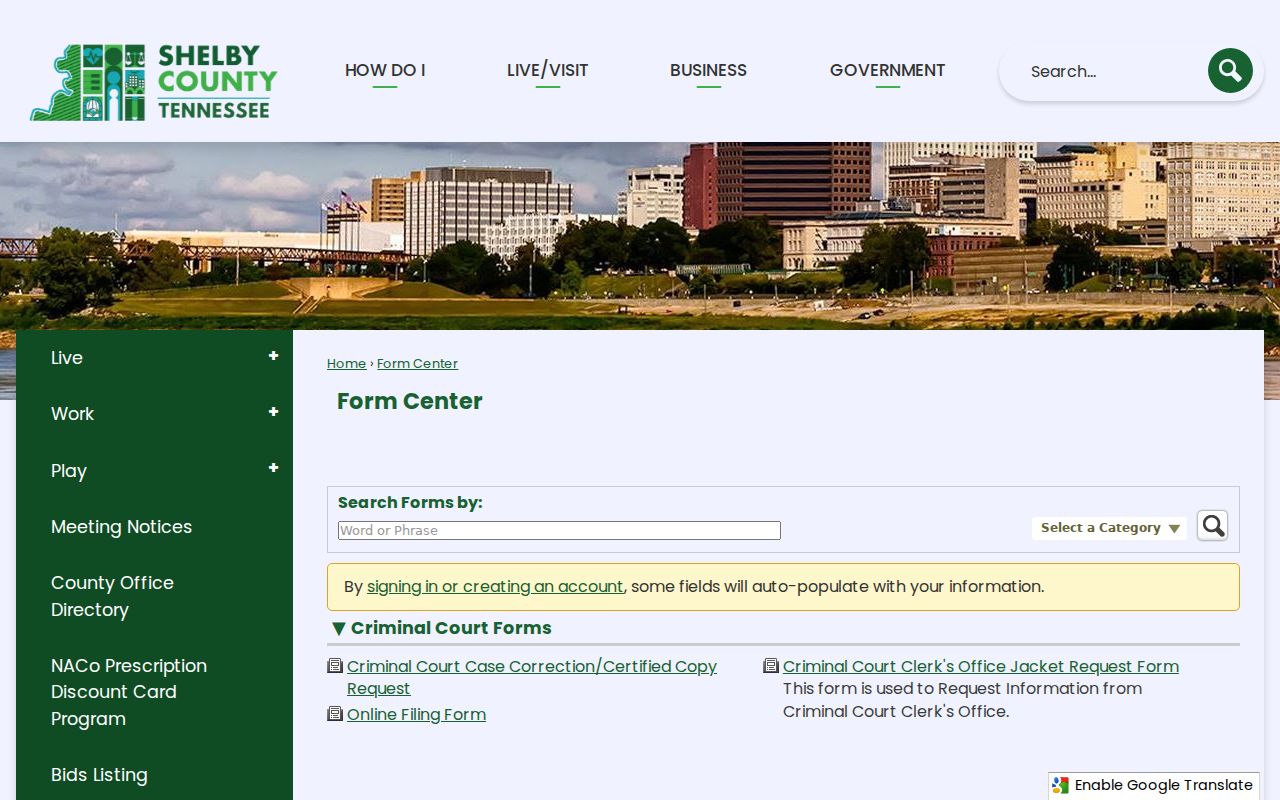
Those separate forms reinforce that viewing a Shelby County docket, correcting a clerk record, and ordering a certified copy are different tasks.
Shelby County Case Dispositions
Outcome terms must be read charge by charge. One count can end differently from another, and a booking label may be amended before judgment. A General Sessions screen may show an early stage while the later felony file holds the final result.
- Nolle prosequi
- The prosecutor formally declines to continue that charge at that time.
- No-bill
- The grand jury declines to approve an indictment.
- Dismissal
- The charge ends without a conviction on that count.
- Acquittal
- A not-guilty finding follows adjudication.
- Judicial diversion
- An eligible Tennessee case may defer judgment and later permit dismissal and expungement after successful completion.
Read the signed order when a short status label is unclear. Screenshots can omit count-level detail, and they are not substitutes for a certified disposition from the Shelby County clerk.
Stages of a Criminal Case
A felony may start with a complaint and preliminary work in General Sessions, then move to Criminal Court after indictment. The prosecutor can alter the charge pursued. Motions, plea talks, or trial follow arraignment, and the judgment states the outcome. Sentencing may occur with the disposition or at a later setting.
Case flow: Charges Filed → Arraignment → Pretrial → Plea or Trial → Disposition → Sentencing
Track the case number and division at each step. If an online result stops before the expected outcome, ask the clerk whether the matter moved courts, remains pending, or has an offline order.
Missing Shelby County Case Records
No online match does not prove that no case exists. A name may be misspelled, an older file may not be indexed in the same way, or a preliminary matter may have moved after indictment. Search each known charge and try the case number. Then call the appropriate clerk unit with the filing or setting date and division.
Federal prosecutions are outside this local path. Shelby County lies in the Western District of Tennessee, and federal dockets use PACER. Juvenile matters also follow restricted procedures rather than the adult public docket.
Note: Search by case number whenever possible because people with the same name can appear in unrelated Shelby County court files.
Access & Restrictions
Tennessee generally permits public access to court records, but access is not absolute. The Tennessee Public Records Act governs many state and local records, while Supreme Court Rule 34 provides the judicial access framework. Juvenile files, sealed or expunged matters, protected victim and minor data, Social Security numbers, financial account data, confidential addresses, and some documents tied to active proceedings can be withheld or redacted.
An online view can be narrower than the paper file. Even the paper file may contain sealed documents that staff cannot release. Ask the Shelby County clerk for the public docket, the specific order, or a certified disposition rather than demanding every record tied to a person. A focused request is easier to locate and less likely to sweep in restricted material.
Shelby County Court Record Channels
Use the channel that matches the record. General Sessions Online Case Review is a free starting point for lower-court activity. The Criminal Court Clerk counter and phone units handle felony files, copies, appeals, warrants, and expungement questions. The Jacket Request routes a physical file to a division. A Tennessee Public Records Act request may help with a defined administrative record, but it does not override judicial confidentiality.
| Need | Best Shelby County Channel | Limit |
|---|---|---|
| Current lower-court event | General Sessions Online Case Review | Not a certified record |
| Felony docket or disposition | Criminal Court Clerk | Some files or documents may be offline |
| Physical case jacket | Online Jacket Request | Requires case and division details |
| Certified judgment | Clerk copy request | Fee may apply; confirm with clerk |
| Appellate matter | Tennessee Appellate Case Search | Does not replace the Shelby trial file |
There is no comprehensive Tennessee public search for all trial courts. Comparing the online screen with the clerk's file is often the only sound way to confirm the full Shelby County case path.
Phone and counter access remain important when the web route fails. Supply the Shelby County case number, division, defendant spelling, and a useful filing or hearing date. Ask whether the clerk can provide inspection, an ordinary copy, or a certified copy, since those products serve different needs. Mail or public-records requests should describe the exact court record and preferred format. The clerk's forms index does not publish one blanket copy fee, so request a current estimate before production. This focused approach also lets staff flag a restricted document without treating the entire public case file as closed.